zkSNRAKSはzero-knowldge(Inputの情報を明かさない)、Succinct(証明のサイズは小さく、検証のコストが小さい)、Non-interactive(ProverとVerifierはインタラクティブなやりとりを必要としない)、Argument of knowlege(命題が真となる値を実際に”知っている”ことをた公式時間の計算資源で証明・検証する)を意味します。
計算を実行する時に発生する状態遷移を変数に対する制約条件として数学的に記述して、入力X,W’と中間の値に対して制約条件が成り立つ時だけ検証をパスするようなProofを生成することができます。x = y + zのような制約条件を全て記述し、最終的にこの制約条件を全て満たしていることを証明できるデータがproofというイメージです。
Venue: Fukutake Hall @UTokyo, Hongo Campus. In-person only.
We are now accepting presentation submissions for DAO Utokyo 2025 from blockchain researchers, including students.
If you would like to present a topic in your blockchain specialization, please submit your application through the website link below with your name, email address, and your proposed presentation content.
Please note that if we receive a large number of applications, a selection process may be implemented. Each presentation will be allocated 10 minutes.
Related Topics
Blockchain scaling
Digital currencies
Mass adoption of blockchain technologies
Note: This event is a non-profit event. Attendance will be free and open to public.
Venue: Fukutake Learning Theater Fukutake Hall B2F @UTokyo, Hongo Campus.
Final Agenda:
Time
Session
13:00 – 13:30
Registration and networking
13:30 – 13:45
Introductions and Welcome Speech: Prof. Soichiro Takagi – UTokyo Tshilidzi Marwala – Rector of UN University Rector of UN University & Under-Secretary-General of the UN
13:45 – 14:45
Session 1: DLT mass adoption case studies (Moderator: Juan Du)
Speakers:
Yen-Lin (Mashbean) Huang – TW-DIW Project, Taiwan MihoHirashita – Crypto Garage Tsuyoshi Hirayama – IBM Juan Du – University of Sydney
14:45 – 15:00
Break
15:00 – 15:45
Session 2: Digital Currencies – Stablecoins, CBDCs (Moderator: Prof. Takagi Soichiro)
Speakers:
Kazumasa Miyazawa – President @ Soramitsu TakayaSugino – Financial Services Agency Javier Garcia Nonay – Global Lead of Digital Assets and Tokentization @ Kaleido
15:45 – 16:00
Break
16:00 – 16:45
Session 3: Blockchain Scaling (Moderator: Oguz Genc)
Speakers:
Arnaud Schenk – Executive Director @ Aztec Foundation (hybrid) Luca Donnoh – L2Beat (hybrid) Ekrem Bal – Cofounder & Chief Scientist @ Citrea (hybrid)
16:45 – 17:00
Closing Remarks: Prof. Noboru Koshizuka – UTokyo
17:00 – 17:30
Networking
DAO UTokyo 2025 is an international conference that will be held as the succeeding event of last year’s DAO UTokyo 2024.
This year’s event will be a single day event, hosted as a part of the Japan Fintech Week.
The focus themes will be case-studies on mass adoption, digital currencies, and cutting edge developments on scaling solutions of blockchain systems.
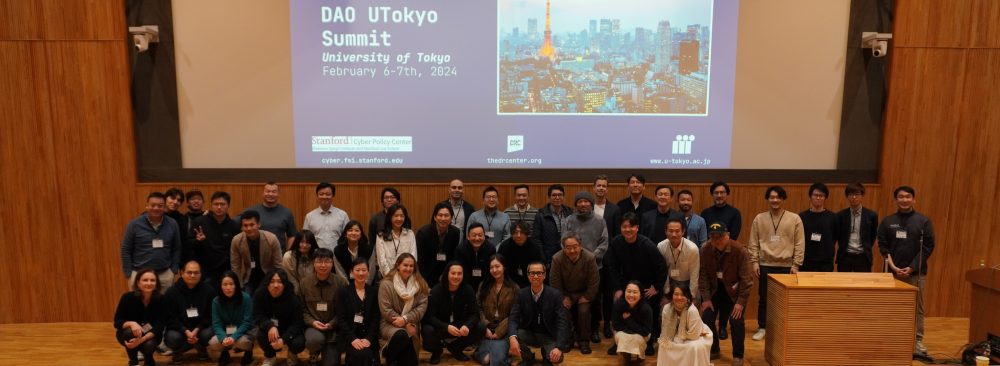
DAO UTokyo was successfully held on February 6-7 with the contribution of approximately 70 participants from Asia, North America, and Australia.
As Blockchain Research Initiative, we would like to convey our sincere gratitude to all parties that contributed to this event.
Below, we include an event report drafted by Hashed Open Research (HOR) Team, an official Conference Joint Statement, and some social media posts by our co-organizers.
Event report:
You may reach the event report prepared by HOR through this link.
Official joint statement:
We, the participants of DAO UTokyo 2024, propose:
1. Intercultural comparisons among countries about DAOs and decentralization.
2. Interdisciplinary collaborations among scholars to study DAOs and co-create new knowledge.
3. Continued education of policymakers and legislators on the beneficial use cases of DAOs.
4. Clarification between confidentiality of private data and application of cryptography.
5. Support for and emphasis of diversity and equity in our communities and circles of influence.
DAO UTokyo is an invitation-only two-day conference that will bring together practitioners, policymakers, and academics to engage in conversation regarding the research, legal, and policy considerations of DAOs (decentralized autonomous organizations) as well as the greater Web3 space in the Asia-Pacific. DAO UTokyo is modeled after the 2023 DAO Harvard Summit and co-hosted by some of the same organizers.
Day 1: Policy Focus. Day 1 will feature lightning talks and short panels by participants from a range of institutions to discuss Web3 policy efforts, successes, and challenges throughout the Asia-Pacific.
Day 2: Research Focus. Day 2 will feature lightning talks and short panels on the role that organizations such as cooperatives, open-source communities, and DAOs are playing in enabling equitable ownership, in addition to the hurdles (legal and otherwise) they are facing. Talks on non-DAO Web3 research are also welcome.
Call For Papers (Optional)
Attendees have the opportunity to submit English-language papers of up to 10,000 words on their topic of choice related to the theme of Web3’s Evolution: DAOs, Other Innovations and Adjacent Technologies for publication in the Stanford Journal of Blockchain Law & Policy. In case of interest, please prepare to speak briefly on your abstract during your DAO UTokyo talk.
The two self-proclaimed properties to the conceptual framework of a DAO as evident as it gets. They are ‘decentralized’ and ‘autonomous.’
After many DAOs have been formed during the past few years, recent studies question whether these fundamental qualities meet expectations. This piece focuses on the ‘decentralization’ aspect of DAOs and how recent research interprets this characteristic.
Some of the literature reviewed in the previous piece displays the controversial debate surrounding the evaluation standards for decentralization. We cited Hassan and De Flippi (2021) for their argument on the lack of consensus on what decentralization or autonomy truly means. We have also seen from The DAO hack that a base layer smart contract network could be forked in extreme cases, which violates the claim of a deterministic immutability. In the early adoption phases of a smart contract networks, ‘decentralization’ is advertised as an innate property of the network; nevertheless, with all the hype around decentralization, such claims eventually get a reality check.
In this piece, we look into some academic and non-academic research that examines the proposition of decentralization within the context of DAOs.
Rikken et al. (2021) refer to the discussion on the word ‘decentralized’ at a semantic level to understand whether it refers to an application that uses a blockchain while stating that smart contract usage is no precondition for the definition of DAOs. This approach is too fundamental since it implies that Bitcoin may also be categorized as a DAO. As discussed in the previous piece, Ethereum is now the leading platform for building DAOs as in the definition of our research. At the same time, we accept that smart contract usage is a natural trait of such organizations as all competitors of Ethereum intersect at the most basic novelty of offering smart contract services.
Another critical point is the distinction between decentralization and autonomy in an operational sense. Decentralization refers to the independence of central control, while autonomy refers to the self-execution of all executive decisions of a DAO.
For this reason, Rikken et al. (2021) claim that recent technical features implemented into so-called DAOs challenge the ‘autonomy’ of DAOs. Off-chain initiatives that separate the decision-making from the execution of the decisions make DAOs less autonomous and run the risk of becoming centralized because the follow-up actions have to be triggered manually and are no longer automatically executed directly based on the decision outcome. These initiatives were identified as decentralized organizations (DOs) instead of DAOs.
This nuance clarifies how autonomy and decentralization are related rather than defining them as distinct attributes. Hence, the hypothesis could be refined by saying that without genuine autonomy, decentralization is not possible. However, we still face the questions; what is decentralization, and how is it achieved?
Therefore a systematic approach to defining ‘decentralization’ for DAOs and to what degrees this can be defined becomes a fundamental research question, to which Axelsen et al. (2022) specifically attend. The authors define a degree of ‘sufficient decentralization’ based on a methodology that samples data through first-order concepts that build up to second-order themes, eventually building up the aggregate dimensions as shown in Figure 1, while Figure 2 details the latter two. Regulatory advisory was sought beforehand to meet the minimal compliance expectations, while the resulting aggregate dimensions are later put through rigorous analysis to evaluate the degree of decentralization to guide regulatory frameworks that are either in their nascent phases or upcoming in most parts of the world.
Figure 1 Data themes for decentralization framework. Source: Axelsen et al. (2022)Figure 2 Details of the data code in themes Source: Axelsen et al. (2022)
This data structure for first order concepts ultimately cover many possible aspects of DAO decentralization from legal, technical, and supervisory approaches while maintaining the autonomy characteristics within the framework. As it turns out, the details are too refined to summarize in this piece. We recommend reading the paper in case readers are extensively interested in how decentralization can be evaluated from a structural framework. Yet, below is a random example:
First order concept: “There should be evidence of distributed token holdings”
Second order theme: Concentration of voting power
Aggregate Dimension: Token Weighted Voting
Source: Axelsen et al. (2022)
Another example for a 1st order concept is “I would expect diversified token holders through distribution methods such as pre-sales token distributions or other distributions” which relate to the same aggregate dimension, yet is affiliated to the second order theme of token distribution at launch.
Although both concepts relate to the concentration of token distribution in theory, which relates to the centralization dimension of token-weighted voting, the distribution phases under the scope are different. The authors introduce many other concepts to approach DAO decentralization from various angles.
The authors continue by presenting their framework to analyze the data structure. They begin by taxonomizing three groups of agents in a DAO network. From top to bottom, the degree of pseudonymity increases while the history of participation shows higher levels of automation in the public wallet addresses, which indicates decreasing levels of vested interest. The definitions for such agents are helpful to understand the centralization analysis regarding the voting power based on token ownership.
Verifiably Independent Agent
Presumably Independent Agent
Unidentifiable Agent
An iterative process and pattern analysis are employed by interviewing a diverse group of experienced industry participants to improve the conceptual data structure. Eventually, a questionnaire framework is formed. While some assessments are quantitative, others are qualitative.
Based on the final framework, the DeFi powerhouse Compound DAO is evaluated according to the framework as a sample evaluation, which shows mixed results yet indicates sufficient decentralization as the network matures, which of course is the outcome within the standards of this framework.
Can decentralization escape subjectivism?
Unfortunately, the evaluation of decentralization can be heavily subjective. Especially in the early phases of any DAO, the founding team will keep the majority of the tokens to have a controlling vote percentage to implement the vision for the product, posing decentralization as a utopian goal to be achieved in the future. However, there is no precedent where gradual decentralization has occurred for a DAO over time. While particular aggregate dimensions mentioned in this article may hypothetically shift toward decentralization, there is not enough research on how DAO decentralization can be evaluated.
Looking at ex-post evidence from more recent DAO votes, we may be able to gain a better understanding of how ‘decentralization’ is taking shape in practice.
The most recent example occurred with the long-awaited token distribution of the popular Ethereum Layer 2 solution Arbitrum DAO held a vote for using about $1 billion worth of its tokens for “Special Grants.” Although the community voted against the proposal, it was revealed that some tokens were already sold by the foundation, leading to an unfathomable defense by the Arbitrum team posted on their forum to communicate that the vote was only to ratify the decision that had already been made by the team.
The backlash by the community was fierce. See the rampant response of Chris Blec, who represents himself as an ardent advocate of decentralization. There are many crypto community members who have expressed similar discontent. Indeed, such events impact future user adaption for DAOs negatively. However, there are other stories that are significant enough to understand the various struggles behind the decentralized governance efforts.
Another prominent example of DAO centralization occurred as a token voting centralization between some of the most renowned actors in the space, namely the famous crypto venture capital fund A16Z and Uniswap DAO, the largest decentralized exchange in the DeFi space. The vote took place to decide the official cross-chain governance for Uniswap, which is a significant decision toward expanding the exchange network to other smart contract platforms. Although A16Z reportedly controls the highest voting power in Uniswap, their tokens only amount to 1.5% of the total sum. The fund abruptly voted against using Wormhole, a competitor of its investment LayerZero, which they favored as the cross-chain governance partner. This decision was unexpected, yet it is essential to note that the total amount of votes was low enough for A16Z to singlehandedly attempt to change the vote result, which they shortly achieved before more votes were casted to reverse the final result. Thus, rather than an issue of voting power centralization, this vote surfaced the need for more community contribution to votes, even for critical decisions.
Another crucial point to remember with this vote is that the voting took place at Tally, a third-party service for DAO votes. Unless the vote takes place on-chain, the decision is not executed automatically, which Rikken et al. (2021) refer to as a violation of the definition of DAO, as we have mentioned in our previous article. Nevertheless, the Uniswap DAO vote was on-chain, preserving its status based on the authors’ definition.
Finally, we look at another community piece that focuses on the “Howey test” to define ‘sufficient decentralization’ within the U.S. regulatory framework. The author argues that the holders of the governance tokens should do so with the expectation of taking profit through the uncoordinated efforts of a broad range of people, which in itself, as an argument, also indicates a high level of subjectivity. There is no answer to what is the minimum sufficient number of people to satisfy the definition for a “broad” range of people. That may be up to regulators to define in the future. Nevertheless, the author uses the Gini coefficient to test the centralization of voting power distribution for renowned DAOs, including Compound and Uniswap, which are mentioned in this article. The results show a very high level of centralization. The author concludes by highlighting the hazards of off-chain governance. The occasional anonymity of the core teams is also highlighted as a critical fault line for certain DAOs that depend on social consensus. Unfortunately, the number of such failed projects is almost too many to count, resulting in diminishing trust for anonymous builders in the decentralized software community.
Conclusion: A more deterministic approach to evaluate DAO decentralization
Notwithstanding all aforementioned research, decentralization research on DAOs requires a more comprehensive framework regarding a systematic analysis that includes some other components constituting a DAO. Instead, to put it in question, how can DAO decentralization be evaluated within a framework that excludes its underlying constituents? Therefore, a minimally comprehensive framework for an analysis of decentralization should contain the following subjects to achieve end-to-end scrutiny for the claims on decentralization:
Web2 layer
Protocol layer
Automation layer
Token layer
Regulation layer
Axelsen et al. (2022) focus on the subjects relevant to numbers 4 and 5 but perhaps chose to exclude the first two as they constitute the underlying infrastructure of DAOs, over which builders and business developers have little control. They do not address these aspects.
In the case of number 1, the relevant web services are almost entirely dominated by cloud infrastructure and content delivery networks that are highly centralized. Meanwhile, it is only possible to evaluate the decentralization of DAOs with their foundational network components, the Layer 1 smart-contract service such as Ethereum. More recently, the scaling networks of Ethereum have shown signs of adoption. Therefore Layer 2 networks on the Ethereum Network need to be incorporated into such a systemic analysis, at least as a disclaimer to the audience.
Lastly, the automation layer needs to be dissected as deeply as possible to understand the extent of the possibilities regarding human intervention. Could the team change the code without a vote if they wanted to do so? Is the DAO vault controlled by a multi-sig wallet, which is solely controlled by the team? Who are the team members? All these questions are crucial as these networks develop to maturity, meaning the centralized control could be imposed at a stage. Just because a network is permissionless, it does not mean that the code or funds are not ultimately controlled by a small group of people. Therefore, immutability is not a prerequisite for permissionless networks. In that case, the approach to the systematization of how decentralization can be evaluated requires a fundamental pivot. The most plausible option would be evaluating decentralization from the perspective of what makes a project exempt from regulatory enforcement.
These discussions lead to another discussion, perhaps a more existential one for DAOs. Although builders have limited options about the tools to use for product development regarding Web2 or protocol layers, they can design services that may limit human involvement in their products to a minimum, which may arguably pose a deterministic alternative against DAOs. We hope to cover this topic in the following article.
Bibliography
Axelsen, Henrik, Johannes Rude Jensen, Department of Computer Science, University of Copenhagen, Universitetsparken 5, DK-2100 Copenhagen, Denmark, Omri Ross, and Department of Computer Science, University of Copenhagen, Universitetsparken 5, DK-2100 Copenhagen, Denmark. 2022. “When Is a DAO Decentralized?” Complex Systems Informatics and Modeling Quarterly, no. 31 (July): 51–75. https://doi.org/10.7250/csimq.2022-31.04.
Hassan, Samer, and Primavera De Filippi. 2021. “Decentralized Autonomous Organization.” Internet Policy Review 10 (2). https://doi.org/10.14763/2021.2.1556.
Rikken, Olivier, Marijn Janssen, and Zenlin Kwee. 2021. “The Ins and Outs of Decentralized Autonomous Organizations (Daos).” SSRN Electronic Journal. https://doi.org/10.2139/ssrn.3989559.
Disclaimer: All generated content is for research purposes only. The author does not and will not provide any investment advice.
The research on DAOs is nascent despite years of development. After much debate, there is yet to be a definitive explanation of what a DAO means, let alone a loose consensus on the fundamentals of DAOs, such as decentralization and anonymity. In this article, we look into the most recent research that attempts to tackle an even more ambitious goal: DAO taxonomy.
If DAOs are companies, it seems daunting to sag companies into groups of specific characteristics. Ziegler and Welpe (2002) attempt to tackle this problem with their research that outlines the differences between categories of DAOs, which they constitute through their systematic taxonomy.
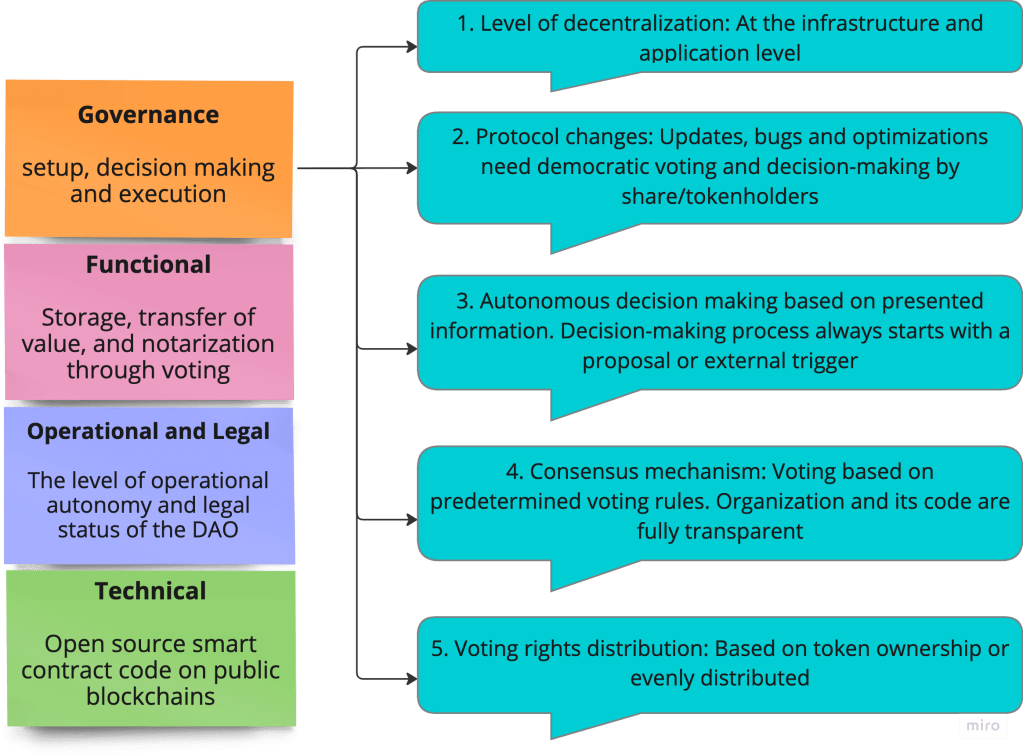
They build upon the former research by Rikken et al. (2021) that probes different definitions for DAOs to develop a sui generis definition. Analyzing thousands of DAOs through different parameters, the authors selectively sieve out specific DAO characteristics through a multilayered perspective to categorize the DAO characteristics into four, as displayed below in Figure 1.
Figure 1 DAO characteristics (Source: Author’s own adopted from Rikken et al. (2021))
The authors continue by analyzing 12 papers based on these characteristics, yet they cannot find a definition that satisfies all characteristics. Hence, they continue with the following definition:
“A DAO is a system in which storage and transaction of value and notary (voting) functions can be designed, organized, recorded, and archived and where data and actions are recorded and autonomously executed in a decentralized way.”
This definition narrows down upon the original DAO attributes we covered in this series’s first article.
Such an exhaustive attempt to study the definition of DAOs proves how challenging it is to do a systematic literature review to bring a universal definition of what a DAO means. Therefore, more trial and error will be needed at the academic level to refine these definitions for DAOs.
One of the most prominent examples of how the definition of DAOs can evolve is the referral to Bitcoin as the first DAO by Ethereum founder Vitalik Buterin (Buterin 2014). Current literature can well differentiate between a DAO and Bitcoin network. Meanwhile, the original DAO attempt by the Ethereum Foundation (The DAO), which we covered in the last article, would instead be categorized as a fundraiser DAO or more like a DAO to manage a fundraiser for an ecosystem grant (Hassan and DeFlippi, 2021).
Going back to wrap up the review of the first article, the authors finally determine three emerging trends in the DAO space:
An early trend that shows Ethereum as the dominant blockchain for DAO formation. While the primary motivation is making use of smart contracts, this trend has important implications regarding the innovation life cycle for DAOs, as we are seemingly moving to the further stages of the technological trajectory where dominant designs are beginning to surface.
The second trend is the release of new platforms that enable standardized DAO establishment, in other words, no-code DAOs. The authors call these parameterized DAOs. Multiple platforms have emerged in competition, leading to many new DAOs.
The latest trend is “off-cain” voting DAOs. To avoid gas costs for increasing contribution to DAO voting, some DAOs have outsourced their governance, separating their execution and decision-making to off-chain platforms. However, the affordable non-smart contract voting models pose issues regarding the centralization and autonomy of DAOs. As automatic smart-contract executions are ruled-out, the finality of voting decisions can be non-deterministic.
Such DAOs with “off-chain” voting mechanisms violate the definition of DAOs, which the authors interpret as no longer being autonomous but only decentralized. This approach is, of course, highly subjective. The authors define a parameter of decentralization based on the number of wallets that hold the DAO token, which is used for voting.
Despite the ongoing regulatory uncertainty around cryptocurrencies, it is essential to state that these reviews are rudimentary. Nevertheless, the literature on DAOs developed to a point where an attempt to build a taxonomy emerged.
Moving towards a taxonomy
Upon covering the deductions of Rikken et al. (2021) regarding the review of existing DAO definitions and the emerging trends in the DAO ecosystem, we turn to Ziegler and Welpe (2022), who take this further and ask, “which common characteristics do DAOs share, and which clusters of DAOs can be created based on their characteristics?”
The taxonomy results consist of three main categories, seven sub-categories, 20 dimensions, and 53 characteristics that we have defined according to the previously explained research method used to describe DAOs. A summary of main and sub-categories are provided in Figure 2.
As a specific example where we can look beyond sub-categories to further detail the DAO characteristics:
Governance Voting is either fully On-Chain or not,
Treasury Setup is either Initial Airdrop or Initial Token Sale,
The Community Meta Purpose is Community Building and Engagement, Product Building and Management, Investing, or Fund Raising.
Figure 2 Main categories and sub-categories based on Ziegler and Welpe (2022).
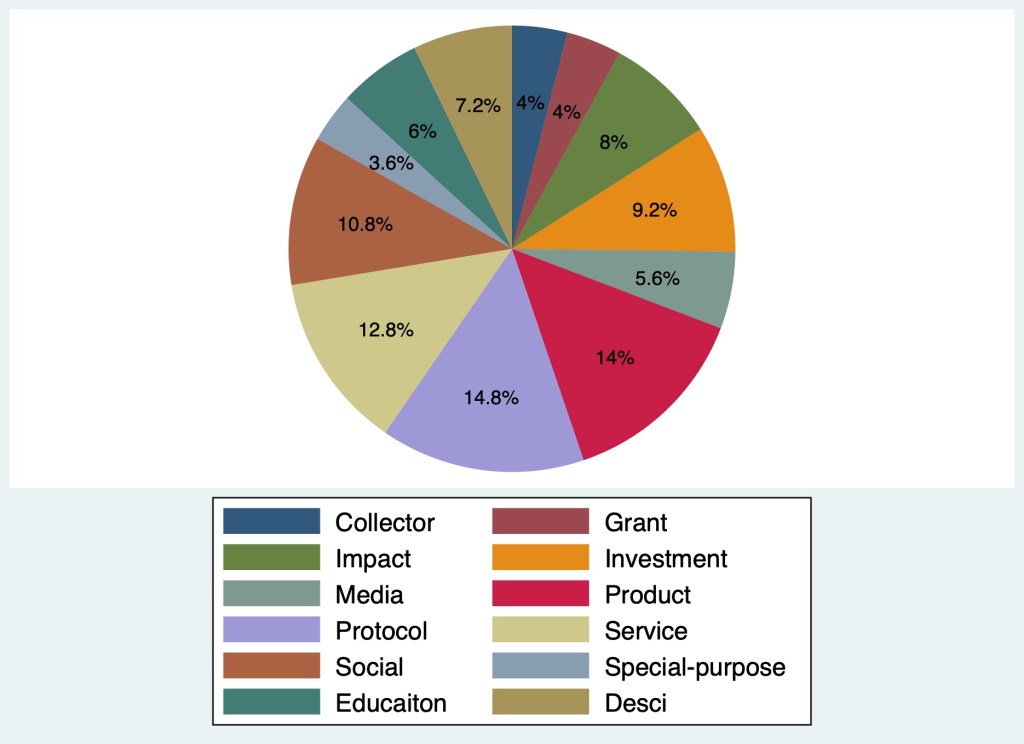
To understand the sheer depth and complexity of the taxonomy, we can highlight the point that the authors use Messari Governor’s DAO database, which only comprises the Community Meta Purpose within the taxonomy. Messari refers to these Community Meta Purposes simply as ‘Types,’ while the authors describe them as “roughly what a DAO’s main goal is.” The following is a list of the categories of DAO types, according to Messari. All definitions for DAO types are borrowed from DAOCentral, which further expands on top of Messari’s categorization to introduce three more types of DAOs. Figure 3 provides a summary of the percentage distribution of each type according to the DAOCentral database.
Collector: DAOs that pool together money to purchase and co-own valuable assets
Grant: DAOs that provide equity-free funding to promising projects
Impact: DAOs that create social impact via a decentralized effort
Investment: DAOs that invest in projects that align with their manifesto
Media: DAOs that create media and entertainment content
Product: DAOs that build projects/products to generate revenue
Protocol: DAOs that build smart contract protocols for decentralized financial services
Service: DAOs that provide professional services as a collective
Social/Community: DAOs that bring like-minded people together in online communities
DAOCentral adds the following categories:
Special-Purpose: DAOs that pool together funds to achieve a specific goal
Education: DAOs that create educational content
Desci: DAOs that are advancing the field of science via a decentralized effort
Figure 3 Types of DAOs according to DAOCentral database (%) (Source: Author’s own based on DAOCentral data).
None of the DAOs have to be exclusively categorized within a single type of DAO described above. One should also note that these are generalized definitions, and there are no clear-cut guidelines regarding why these definitions are appropriate to represent the business models of existing DAOs.
Ziegler and Welpe (2002) ran a series of expert interviews to collect further feedback on the taxonomy regarding perceived qualities of preciseness, completeness of attributes, extensibility, and clarity on a scale from one to ten. The average score for preciseness comes back at 8.5, while completeness returns a score of 8, extensibility 7.3, and clarity 7.1. It should be no surprise that clarity returns the lowest score, as we have seen throughout this article that the most organized efforts to define and categorize DAOs in the academic literature are hitting the stone wall of sheer complexity.
Such results should not be surprising as DAOs are new organizational primitives with ambiguous legal characteristics. They do not operate in any clear-cut scope of business. As the scope can be broad, it becomes increasingly challenging to categorize a DAO since corporations converge all their duties for legal, financial, business, and so forth under the umbrella of technical innovations introduced by smart contract applications of public blockchains. In a few years, it would not be surprising to see a brand new taxonomy that debunks today’s work. It all depends on the level of adoption we will see moving forward.
Hassan, Samer, and Primavera De Filippi. 2021. “Decentralized Autonomous Organization.” Internet Policy Review 10 (2). https://doi.org/10.14763/2021.2.1556.
Rikken, Olivier, Marijn Janssen, and Zenlin Kwee. 2021. “The Ins and Outs of Decentralized Autonomous Organizations (Daos).” SSRN Electronic Journal. https://doi.org/10.2139/ssrn.3989559.
Although DAOs have become popular within the past two years, the concept’s inception goes back a decade. Dan Larimer put forward the original concept in 2013, as he named Decentralized Autonomous Corporations (DACs) as a blockchain governance system that would be an improvement over the Bitcoin protocol. He founded the first DAC, Bitshares, an e-commerce platform to decentralize the authority between merchants and customers.
However, it was not until 2016 when DAOs made the mainstream news. The Ethereum Foundation decided to start a digital investment fund built on their blockchain. A third-party company (Slock.it) founded by former executives of the Ethereum Foundation wrote the code. Deployed as open-source code on a smart contract, anyone could retrieve DAO tokens at a 1 to 100 rate for Ether. The crowdsourced participation was an unprecedented success as 12.7 million Ether was sent to the unique address of The DAO. At its peak, these tokens were worth as much as $250 million [1].
The purpose of The DAO was similar to an ecosystem fund of any smart contract foundation like Ethereum. However, unlike an ecosystem fund, The DAO relied on community engagement rather than an executive team to manage the fund. Anyone could pitch their ideas and get funding from The DAO, while the token holders would be eligible to vote on who gets the funding. As we will see in the following article, this type of DAO that manages the treasure of a blockchain-based business has become ubiquitous.
The hack
By the summer of 2016, The DAO was giving signals for what would come next year in the ICO craze. There was a strong interest in crypto assets, and Ethereum was poised to make a breakthrough only after a year of its inception. However, what happened next became one of the most controversial events in the blockchain industry.
Less than three months after the launch of The DAO, an attacker found a vulnerability in the source code, which allowed repeated calling of the “split” function, named descriptively as the reentrancy exploit. [2] provide the vulnerability in code and summarize the exploit process in three steps.
Create a new DAO by splitting the DAO.
Withdraw funds into the new DAO.
Repeatedly call the new DAO.
Source: Reproduced from Dillon et al. (2017)
Dealing with a harsh blow to the credibility of the nascent smart-contract business, the Ethereum core team made a tough decision. The attacker was a “blackhat” hacker, stealing about $70 million of the funds. A “whitehat” hacker group assembled to reproduce the attack faster than the original hacker so that the funds would be exploited into safe hands and returned to the investors [3]. Trust in DAOs was indeed shaken. Nevertheless, in a desperate attempt to save the user funds, the Ethereum core team decided to implement a hard-fork at block number 1,920,000. The fork’s function was moving the stolen funds to a ‘withdraw-only’ wallet, where the DAO token holders could retrieve their funds.
The hard fork stirred opposing arguments from different parties. To begin with, the hacker(s) published an open letter and argued that the right to exploit the vulnerability of open-source software is within the nature of this business.
Controversy ensues
However, a group of Ethereum miners thought that immutability and neutrality were fundamental aspects of blockchain-based governance as they continued to mine blocks on the original chain. The ideological split regarding the violation of immutability is the best summary of the political grift in the crypto assets ecosystem to this day. If the history of the blockchain is altered to bail out a particular group, then the core principles of blockchain are violated from a fundamentalist’s perspective. Thus, the same violations may happen in the future for other random reasons.
Desperate times bring desperate measures. Ethereum moved on from The DAO hack as miners sided with restoring user funds. The nascency of the ecosystem was an advantage for the Ethereum core team and the community regarding implementing such a swift fix. Essentially, DAOs have the objective of corporate governance would be replaced in a unique case where IT management would be the only management [4]. Lacking corporate governance and in-place organizational processes to manage such an attack has disadvantages. Nevertheless, the ability to move fast is another function of centralization, which is advantageous under such circumstances.
Are we getting the Web3 fundamentals right?
Future security or political events may stir further controversy about the significant governance decisions within the smart contract industry and the relevant disputes with the fundamentalist. However, an important lesson to learn from The DAO hack is that the terms such as “blockchain” and “decentralization” are used in misleading ways.
Blockchain refers to immutable ledgers. Meanwhile, decentralization vaguely refers to distributed forms of governance and security. The DAO hack taught us that these are not the case. For this reason, I tried to clarify the fundamental concepts of Web3 in our first article on DAO research series. Getting the fundamentals right is the key to avoid confusion in Web3 space.
Lastly, it is worth noting that it may be better that some human intervention is still possible when people’s money is at stake. With the recent meltdown of centralized finance platforms, most notably FTX, we have seen that the thing that matters the most is the customer funds when an outlier event that leads to the loss of funds occur. Otherwise, the confidence in the novel primitives such as DAOs and other Web3 applications are deeply shaken. Although decentralization fundamentalism sounds good in theory, once you are the one who is suffering from loss of funds, it may not be so attractive anymore. Yet, it is undeniable that such tradeoffs in decentralized system designs are likely to have other consequences sooner or later.
[2] Dhillon, Vikram, David Metcalf, and Max Hooper. 2017. “The DAO Hacked.” In Blockchain Enabled Applications: Understand the Blockchain Ecosystem and How to Make It Work for You, edited by Vikram Dhillon, David Metcalf, and Max Hooper, 67–78. Berkeley, CA: Apress. https://doi.org/10.1007/978-1-4842-3081-7_6.
[4] Morrison, Robbie, Natasha C. H. L. Mazey, and Stephen C. Wingreen. 2020. “The DAO Controversy: The Case for a New Species of Corporate Governance?” Frontiers in Blockchain 3 (May): 25. https://doi.org/10.3389/fbloc.2020.00025.
Disclaimer: All generated content is for research purposes only. The author does not and will not provide any investment advice.
In this article, we would like to provide some non-academic resources for DAO research. While academic studies are focusing on decentralized autonomous organizations a lot more recently, community research on DAOs also provides valuable resources. Most of the data analytics and day-to-day research is mainly done via services that are either DAOs or private businesses. In a way, the research on DAOs is also decentralized, making it challenging to access DAO-related data publicly. Nevertheless, some learning materials can be found in aggregated formats. Below are a few resources that can help any curious mind to get started with DAO research.
Data Analytics
For data analytics wizards with SQL knowledge, Dune Analytics is the most comprehensive blockchain data analytics tool that is free and relies on community engagement. However, it is possible to search for DAO-related dashboards rather than having to build a dashboard. It is not free to export analysis in CSV format, unfortunately. Go to Dune and type DAO in the search bar to get started. Specific searches for popular DAO platforms return dozens of results. For example, a dashboard for DAO treasuries still needs to be built, and it would be a handy tool.
Databases and Metrics
Deep DAO is a comprehensive DAO metrics analytics tool with a paid API. Users can analyze the activity in a DAO not just by checking their rankings in terms of finances but also their governance activity to measure community engagement, such as the number of votes, number of governance proposals, number of participants, and number of token holders. These metrics can also define a degree of decentralization for DAOs. Data can be filtered based on the smart-contract service provider, which can be used to do comparative research between different base-layer protocols.
Messari is a crypto analytics company that provides DAO metrics and a tool to participate in DAO analytics. They streamline the process of filtering the active and past proposals for many DAOs, which can be filtered into nine categories and many other tags. We will get into these categories in the following article. For any DAO that is looked up, Messari feeds similar DAOs, making comparative research easier. DAOs can also be filtered based on their smart-contract provider as well. The company also releases comprehensive research reports on the outlook of the crypto industry, including DAOs. Unfortunately, many advanced features require a subscription.
Other platforms also provide similar data, such as Boardroom, which provides a specific feed of governance proposals for DAOs. At the same time, Tally combines another DAO exploration database that allows filtering based on the smart contract platform, showing which DAOs have active proposals and other engagement metrics.
General Research
The DAO Research Collective (DRC) is an open-source non-profit for aggregating and curating DAO research for the community and facilitating interactions between academics and operators.
Another proactive group that publishes regular DAO research is BanklessDAO. They also keep their directory, which various tags can filter. For anyone who would like to read two or three blog posts per month to keep updated on the developments in the DAO landscape, Bankless DAO is an active DAO that does this regularly. Some of the DAO members also engage in academic research. They also keep their own directory, which can be filtered by a variety of tags.
Realistically, learning about a particular DAO will take someone to join the particular community of a DAO. The social environment where DAOs convene is an application called Discord. Starting as a chat and streaming app for gamers, Discord became the go-to communication channel for cryptocurrency communities, which includes DAOs. So whatever Slack is to business and academic communities, Discord has become the central platform for communication for decentralized businesses.
Disclaimer: The author does not have any conflict of interest regarding the entities mentioned in this piece.
Disclaimer: All generated content is for research purposes only. The author does not and will not provide any investment advice.










 東京大学情報学環 ブロックチェーン研究イニシアティブ