Author: Oguz Genc
The research on DAOs is nascent despite years of development. After much debate, there is yet to be a definitive explanation of what a DAO means, let alone a loose consensus on the fundamentals of DAOs, such as decentralization and anonymity. In this article, we look into the most recent research that attempts to tackle an even more ambitious goal: DAO taxonomy.
If DAOs are companies, it seems daunting to sag companies into groups of specific characteristics. Ziegler and Welpe (2002) attempt to tackle this problem with their research that outlines the differences between categories of DAOs, which they constitute through their systematic taxonomy.
They build upon the former research by Rikken et al. (2021) that probes different definitions for DAOs to develop a sui generis definition. Analyzing thousands of DAOs through different parameters, the authors selectively sieve out specific DAO characteristics through a multilayered perspective to categorize the DAO characteristics into four, as displayed below in Figure 1.
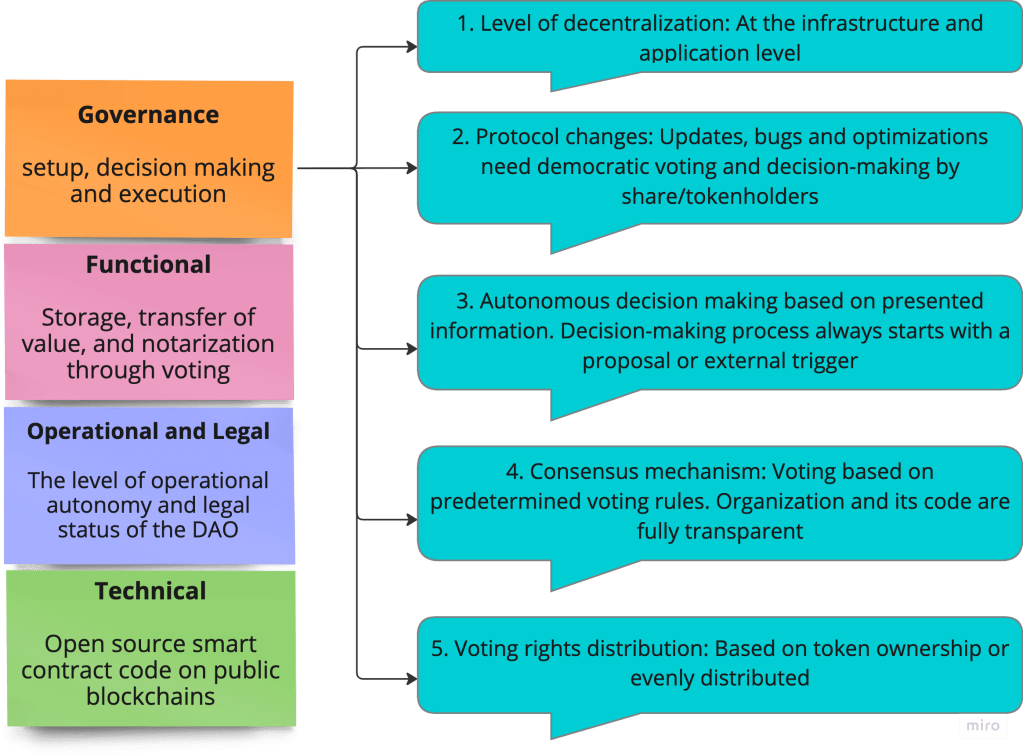
The authors continue by analyzing 12 papers based on these characteristics, yet they cannot find a definition that satisfies all characteristics. Hence, they continue with the following definition:
“A DAO is a system in which storage and transaction of value and notary (voting) functions can be designed, organized, recorded, and archived and where data and actions are recorded and autonomously executed in a decentralized way.”
This definition narrows down upon the original DAO attributes we covered in this series’s first article.
Such an exhaustive attempt to study the definition of DAOs proves how challenging it is to do a systematic literature review to bring a universal definition of what a DAO means. Therefore, more trial and error will be needed at the academic level to refine these definitions for DAOs.
One of the most prominent examples of how the definition of DAOs can evolve is the referral to Bitcoin as the first DAO by Ethereum founder Vitalik Buterin (Buterin 2014). Current literature can well differentiate between a DAO and Bitcoin network. Meanwhile, the original DAO attempt by the Ethereum Foundation (The DAO), which we covered in the last article, would instead be categorized as a fundraiser DAO or more like a DAO to manage a fundraiser for an ecosystem grant (Hassan and DeFlippi, 2021).
Going back to wrap up the review of the first article, the authors finally determine three emerging trends in the DAO space:
- An early trend that shows Ethereum as the dominant blockchain for DAO formation. While the primary motivation is making use of smart contracts, this trend has important implications regarding the innovation life cycle for DAOs, as we are seemingly moving to the further stages of the technological trajectory where dominant designs are beginning to surface.
- The second trend is the release of new platforms that enable standardized DAO establishment, in other words, no-code DAOs. The authors call these parameterized DAOs. Multiple platforms have emerged in competition, leading to many new DAOs.
- The latest trend is “off-cain” voting DAOs. To avoid gas costs for increasing contribution to DAO voting, some DAOs have outsourced their governance, separating their execution and decision-making to off-chain platforms. However, the affordable non-smart contract voting models pose issues regarding the centralization and autonomy of DAOs. As automatic smart-contract executions are ruled-out, the finality of voting decisions can be non-deterministic.
Such DAOs with “off-chain” voting mechanisms violate the definition of DAOs, which the authors interpret as no longer being autonomous but only decentralized. This approach is, of course, highly subjective. The authors define a parameter of decentralization based on the number of wallets that hold the DAO token, which is used for voting.
Despite the ongoing regulatory uncertainty around cryptocurrencies, it is essential to state that these reviews are rudimentary. Nevertheless, the literature on DAOs developed to a point where an attempt to build a taxonomy emerged.
Moving towards a taxonomy
Upon covering the deductions of Rikken et al. (2021) regarding the review of existing DAO definitions and the emerging trends in the DAO ecosystem, we turn to Ziegler and Welpe (2022), who take this further and ask, “which common characteristics do DAOs share, and which clusters of DAOs can be created based on their characteristics?”
The taxonomy results consist of three main categories, seven sub-categories, 20 dimensions, and 53 characteristics that we have defined according to the previously explained research method used to describe DAOs. A summary of main and sub-categories are provided in Figure 2.
As a specific example where we can look beyond sub-categories to further detail the DAO characteristics:
- Governance Voting is either fully On-Chain or not,
- Treasury Setup is either Initial Airdrop or Initial Token Sale,
- The Community Meta Purpose is Community Building and Engagement, Product Building and Management, Investing, or Fund Raising.

To understand the sheer depth and complexity of the taxonomy, we can highlight the point that the authors use Messari Governor’s DAO database, which only comprises the Community Meta Purpose within the taxonomy. Messari refers to these Community Meta Purposes simply as ‘Types,’ while the authors describe them as “roughly what a DAO’s main goal is.” The following is a list of the categories of DAO types, according to Messari. All definitions for DAO types are borrowed from DAOCentral, which further expands on top of Messari’s categorization to introduce three more types of DAOs. Figure 3 provides a summary of the percentage distribution of each type according to the DAOCentral database.
- Collector: DAOs that pool together money to purchase and co-own valuable assets
- Grant: DAOs that provide equity-free funding to promising projects
- Impact: DAOs that create social impact via a decentralized effort
- Investment: DAOs that invest in projects that align with their manifesto
- Media: DAOs that create media and entertainment content
- Product: DAOs that build projects/products to generate revenue
- Protocol: DAOs that build smart contract protocols for decentralized financial services
- Service: DAOs that provide professional services as a collective
- Social/Community: DAOs that bring like-minded people together in online communities
DAOCentral adds the following categories:
- Special-Purpose: DAOs that pool together funds to achieve a specific goal
- Education: DAOs that create educational content
- Desci: DAOs that are advancing the field of science via a decentralized effort
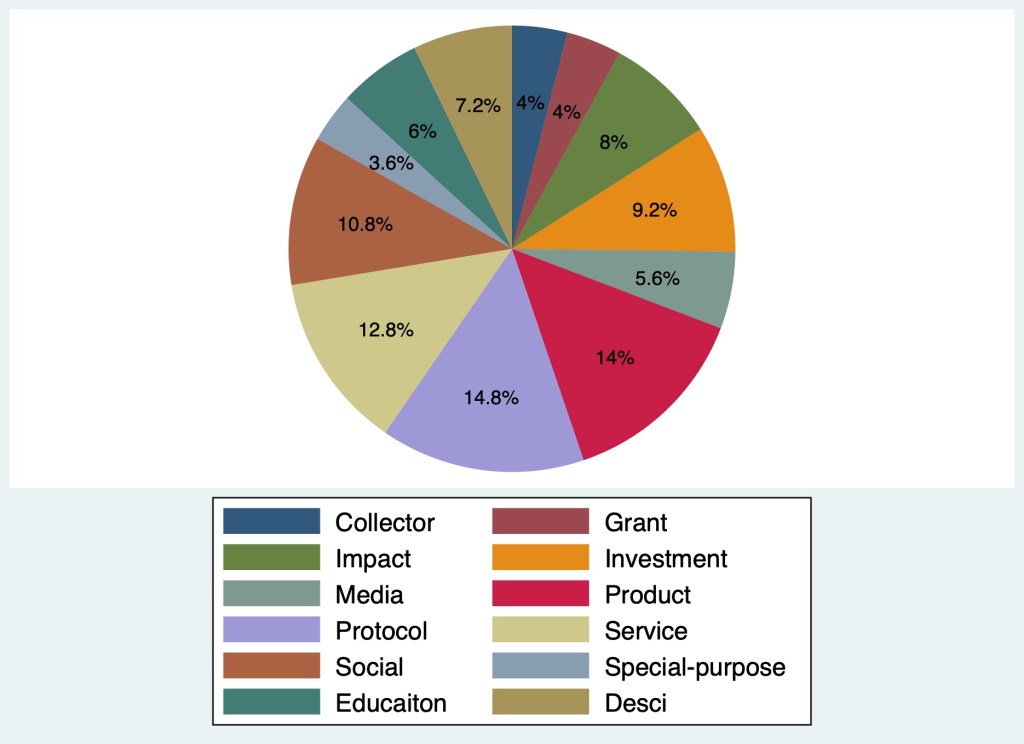
None of the DAOs have to be exclusively categorized within a single type of DAO described above. One should also note that these are generalized definitions, and there are no clear-cut guidelines regarding why these definitions are appropriate to represent the business models of existing DAOs.
Ziegler and Welpe (2002) ran a series of expert interviews to collect further feedback on the taxonomy regarding perceived qualities of preciseness, completeness of attributes, extensibility, and clarity on a scale from one to ten. The average score for preciseness comes back at 8.5, while completeness returns a score of 8, extensibility 7.3, and clarity 7.1. It should be no surprise that clarity returns the lowest score, as we have seen throughout this article that the most organized efforts to define and categorize DAOs in the academic literature are hitting the stone wall of sheer complexity.
Such results should not be surprising as DAOs are new organizational primitives with ambiguous legal characteristics. They do not operate in any clear-cut scope of business. As the scope can be broad, it becomes increasingly challenging to categorize a DAO since corporations converge all their duties for legal, financial, business, and so forth under the umbrella of technical innovations introduced by smart contract applications of public blockchains. In a few years, it would not be surprising to see a brand new taxonomy that debunks today’s work. It all depends on the level of adoption we will see moving forward.
Buterin, Vitalik. 2014. “DAOs, DACs, DAs and More: An Incomplete Terminology Guide.” Ethereum Foundation Blog. May 6, 2014. https://blog.ethereum.org/2014/05/06/daos-dacs-das-and-more-an-incomplete-terminology-guide.
Hassan, Samer, and Primavera De Filippi. 2021. “Decentralized Autonomous Organization.” Internet Policy Review 10 (2). https://doi.org/10.14763/2021.2.1556.
Rikken, Olivier, Marijn Janssen, and Zenlin Kwee. 2021. “The Ins and Outs of Decentralized Autonomous Organizations (Daos).” SSRN Electronic Journal. https://doi.org/10.2139/ssrn.3989559.
Ziegler, Christian, and Isabell Welpe. 2022. “A Taxonomy of Decentralized Autonomous Organizations.” ICIS 2022 Proceedings, December. https://aisel.aisnet.org/icis2022/blockchain/blockchain/1.
Disclaimer: All generated content is for research purposes only. The author does not and will not provide any investment advice.
 東京大学情報学環 ブロックチェーン研究イニシアティブ